Cucuzza is the long, pale-green squash so beloved by Sicilians for its slightly sweet cream-colored flesh. Technically cucuzza is a gourd rather than a squash. In the United States, it’s typically found in late summer and most prominently in August. In Sicily, I’ve found it in the markets as early as late May. This Stracotto di Cucuzza recipe is high in fiber and in vitamin C. Here are some facts on Cucuzza.
It grows on vines, which must be trellised so the fruit hangs above the ground. The vines can grow up to two feet in one day and the fruit as much as ten inches a day, often reaching a length of three feet at maturity. It can grow straight or with a curve, with the diameter ranging from around an inch to as large as three inches. Choose smaller-diameter cucuzza for culinary purposes. The larger-diameter, more mature fruit develop a large spongy interior of seeds, which must be scooped out before cooking.
The first time I cooked it I made the terrible mistake of not peeling the thin green, innocent-looking skin. The result: after cooking, the skin turned as hard as plastic. These gourds are easily peeled with a vegetable peeler. Cucuzza are as versatile as any squash, but I prefer this stracotto, which means stew, made with onions, tomatoes, and fresh herbs.
It’s fortuitous that these ingredients are at their prime concurrently in August. In Palermo’s markets, you find piles and piles of cucuzza (as seen in the accompanying photo taken in the Ballaró Market), and I believe the quality is higher than those I’ve bought in America, though our crop is perfectly fine.

Cucuzza Squash In Sicily.
Most Sicilian-Americans who maintain vegetable gardens grow it, as my grandfather did. It’s not readily available in the U.S., but I’ve noticed that many farmer’s markets, particularly those stands run by Italians, feature it, in August. Some specialty food shops often carry it as well, and a few years ago even my local supermarket in Manhattan stocked it (no longer unfortunately). Though I’ve never used the service, I’ve heard that cucuzza can be ordered on Wegmans website in season.
If you are unable to find it, you can substitute lita, zucchini ,or other summer squash. However, the taste and texture will be significantly different.
Unlike zucchini, cucuzza maintains a firmer crunchier texture after cooking. This stracotto makes a wonderful side dish, but for a whole vegetarian meal, it can be served over pasta, rice, or polenta.
I have been unable to find cucuzza for several years now because the Italian farm stand, where I used to buy it, no longer grows it. Then this week, I happened to notice that another stand, which is run by Asians, had some small cucuzza, which they call by another name I could not discern. Who knew that Asians cook this gourd, too?
Select cucuzza that are firm, unblemished, and have a bit of stem still attached. The stem continues to feed the squash even after cutting. Peel the squash with a vegetable peeler, and slice it in half lengthwise.

Peel the cucuzza.
If the center is seedy, scrape all the seeds out, cut off the stem, then cut into bite-sized cubes.

Scrape out the seeds.
In small batches, brown the cubes in the olive oil in a Dutch oven or large pot until it just turns golden.

Fry the cubes.
Remove with a slotted spoon, season lightly with salt and pepper, and continue with the remainder of the squash.

Season the cubes.
Dip the tomatoes in boiling water for about 10 seconds and remove.

Plunge the tomatoes in boiling water.
Cut out the cores and slip off the peels.

Skin the tomatoes.
Cut the tomatoes in half. Gently squeeze out the juice and seeds into a sieve placed over a bowl.

Squeeze out the seeds.
Save the sieved juice in case you need it to moisten the stew. Coarsely chop the tomatoes.

Chop the tomatoes.
Sauté the chopped onion in the remaining olive oil until golden, adding more olive oil if necessary. In this case, I used a red onion, but you can use either red or white. When the onion is nearly golden, add the minced garlic and cook for 2 minutes, stirring. Do not let the garlic brown.

Sauté the onions, garlic, and herbs.
Add the chopped tomato pulp, stirring until it begins to disintegrate. Add the cucuzza, the herbs, salt and pepper to taste.

Add the tomatoes, basil, and cucuzza.
Simmer for 30-45 minutes, until the ingredients are blended and the stew has a good consistency. If it is too dry, add the reserved tomato juice.
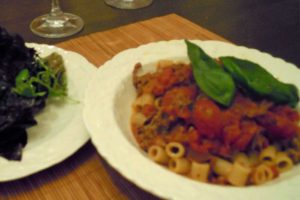
Serve Stracotto di Cucuzza with more fresh chopped basil on top, either as a side dish or over pasts, rice, or polenta. In this instance, I serve it with a Gemilli-type pasta.

Serving the stracotto di cucuzza with pasta.