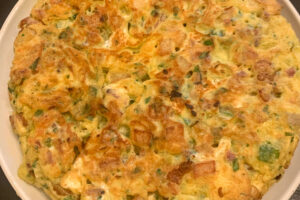
Despite the ridiculous book, Real Men Don’t Eat Quiche, Quiche Lorraine is one of my favorite luncheon dishes. It can also be served as a first course. The shell can be made as much as a day ahead of serving, and the filling can come together in a very short time and refrigerated until needed. Here is a short history of the dish.
To Go Directly to the Recipe, Click Here.
For the Shell
Place the flour and salt in the bowl of a food processor and process for 1 minute. Grate the butter on the large holes of a grater directly into the flour in the processor. (If you don’t have a processor, this can be done by hand. For handmade, you should reduce the amount of shortening by 2 tablespoons.)
I’ve found that grating the butter creates the flakiest, most tender crust. If you don’t want to go to the trouble of grating, you can achieve excellent results by cutting up very cold or frozen butter.
Cut the frozen lard or vegetable shortening into tiny pieces with a sharp, heavy knife and add it to the processor.
Pulse just until very coarse crumbs are formed. You should still see small pieces of butter.

Pulse to form coarse crumbs.
With the processor running, gradually add the ice water a tablespoon at a time. Stop adding water as soon as the pastry begins coming together.

Process until the pastry comes together.
Remove the pastry from the processor, and form it into a ball.

Form the dough into a ball.
Knead slightly on a floured board to form a flat disk.

Flatten the pastry into a disk.
Wrap the pastry in plastic and refrigerate several hours or overnight. I find that overnight chilling makes the pastry much easier to roll out.
Lightly butter the bottom and sides of a 9-inch quiche pan. Place a rack in the middle level of the oven and preheat it to 425°.
Let the pastry sit out of the refrigerator for about 7 minutes, so it doesn’t crack when it’s rolled. Roll out the pastry on a lightly floured board about 1 1/2 inches larger than the bottom of your pan. Keep moving and revolving the pastry to ensure that it doesn’t stick.

Roll the pastry.
Wrap the pastry around the rolling pin.

Wrap the pastry around the rolling pin.
Line an 8- to 9-inch quiche pan or pie plate with with the pastry by carefully unrolling the it over the pan.

Line the pan with the pastry.
Chill the pastry in the freezer for at least 15 minutes. This prevents shrinking and promotes a flakier crust. Gently line the pastry with aluminum foil, and fill the shell with beans or rice to weight it down.

Line the pastry with foil and beans.
Place it in the oven and bake for about 12 minutes or so until the pastry is set. Remove the shell from the oven, and carefully remove the beans and foil. Prick the bottom of the pastry with a fork to keep it from rising.

Prick the pastry.
Return the shell to the oven and bake a few more minutes until it is very lightly colored. Remove the shell and let it cool on a rack.
For the Filling
Cut the chunk bacon into lardons about 1/2-inch long and 1⁄4-inch thick. If you can’t find chunk bacon, buy the thickest -cut bacon you can find.

Cut the bacon.
Sauté the lardons in a skillet until lightly browned.

Fry the bacon.
Gently press the lardons into the bottom of the pastry shell. (They may not adhere.)
Move the oven rack to the upper-third level and preheat the oven to 375°. Place a baking sheet on the rack while the oven is preheating. Placing the quiche on a hot baking sheet will help bake the bottom of the quiche better and the sheet will also catch any drippings from the quiche while it is baking.
In a bowl, beat the eggs with the salt, pepper, and nutmeg until frothy, then gradually beat in the milk and cream until well combined.
Purists maintain that Quiche Lorraine should never have cheese, but I think that cheese enhances the dish enormously. My preferred cheese for Quiche Lorraine is Gruyère. Grate the Gruyère

Grate the cheese.
Then simply stir the cheese into the filling.

Mix in the cheese.
Place the pastry shell on the heated baking sheet and pour the filling into the shell.

Pour the filling into the shell.
I find it much easier to pour the filling into the shell when it’s already on the baking sheet. It avoids the risk of spilling the custard when trying to move it to the oven.
Distribute tiny dots of the butter over the top. Bake for 25 to 30 minutes until the quiche is puffed and browned.

Bake the quiche.
Place the Quiche Lorraine on rack, remove the outer ring, and serve it warm or at room temperature.

It will remain puffed for about 10 minutes. You can also refrigerate any leftover Quiche Lorraine and reheat it in a 350° oven, though it will no longer be puffed.